

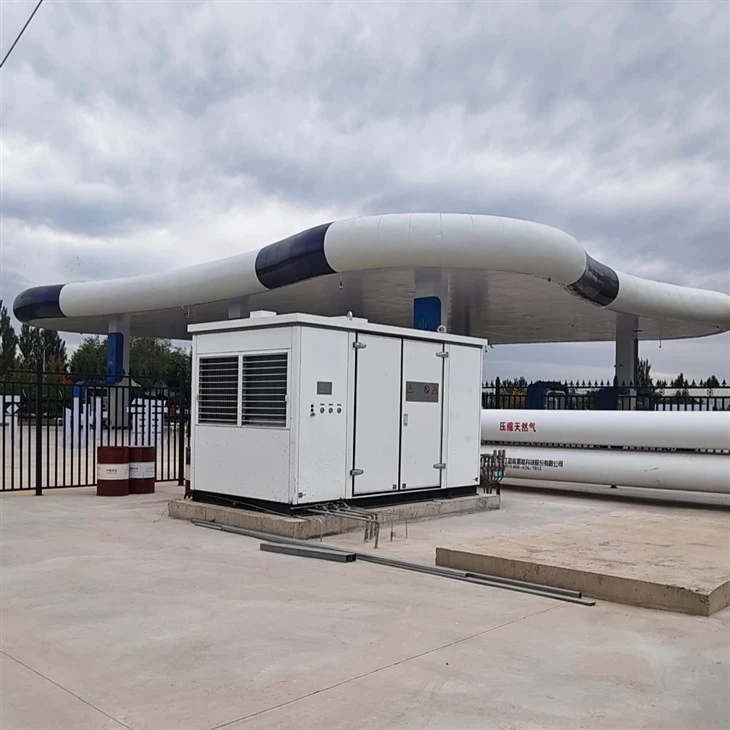
The Portable CNG Fueling Station is a containerized mobile refueling system designed to supply CNG to vehicles in areas without direct natural gas pipeline access. It integrates gas unloading, hydraulic compression, cascade storage and vehicle dispensing into a 20ft container.
It is suitable for CNG station investors, fleet operators, mining companies, EPC contractors and industrial project developers who need a relocatable refueling facility for remote or temporary operations.
Integrated Equipment Configuration
The ZXRY1000-II combines the main equipment required for tube-trailer-based CNG refueling in one containerized unit.
|
Main Equipment |
Configuration |
|
Compressor |
DRY1000 hydraulic piston compressor |
|
CNG Storage |
ZIP-270 cascade, 1.5 m³ water volume |
|
Dispensing System |
2 × dual-hose CNG dispensers |
|
Trailer Unloading |
1 × single-hose unloading post |
|
Flow Measurement |
E+H mass flow meters |
|
Control System |
Siemens PLC and Smart700 touchscreen |
|
Cooling System |
Closed-loop water circulation with air cooling |
Operating Process
Tube Trailer Unloading → Hydraulic Compression → Cascade Storage → Vehicle Dispensing
The unloading connection receives compressed natural gas from tube trailers. The compressor raises the gas pressure for storage and dispensing, while the PLC coordinates equipment operation and pressure sequencing.
Hydraulic Compression and Gas-Oil Separation
The station uses a DRY1000 hydraulic-driven reciprocating piston compressor with a two-stage compression configuration. Its gas chamber and hydraulic oil chamber are separated by a multi-stage sealing arrangement to reduce the risk of oil entering the compressed gas stream.
Key compressor components include:
• Parker sealing components for piston and rod sealing.
• SKF piston seals.
• Simrit oil seals.
• Hydraulic drive system with pressure monitoring and overpressure protection.
The gas-side lubrication arrangement is designed to minimize oil contamination during compression. Actual sealing performance depends on component condition and maintenance.
Dispensing and Storage Configuration
The dispensing system includes two dual-hose CNG dispensers and one separate single-hose tube trailer unloading post.
|
Component |
Specification |
|
CNG Dispensers |
2 × dual-hose dispensers |
|
Dispenser Model |
JQD-B30B(3MSW) |
|
Dispenser Flow Rate |
1–20 Nm³/min per hose |
|
Dispenser Accuracy |
±1.0% |
|
Flow Meters |
E+H mass flow meters |
|
Storage Cascade |
ZIP-270 cylinders |
|
Storage Water Volume |
1.5 m³ at 250 bar |
|
Unloading Post |
1 × single-hose |
|
Unloading Flow Rate |
1–56 kg/min |
|
Hose Protection |
Breakaway valves |
The ZIP-270 cascade provides intermediate high-pressure gas storage between compression and dispensing. Its 1.5 m³ specification refers to cylinder water volume, not the actual volume of compressed natural gas stored.
The dispenser flow rate is specified per hose and should not be interpreted as the guaranteed continuous output of the entire station. Actual dispensing capacity depends on compressor output, trailer inlet pressure, cascade pressure and the number of vehicles being refueled simultaneously.
Technical Specifications
|
Parameter |
Specification |
|
Model |
ZXRY1000-II |
|
Gas Medium |
Natural Gas (CNG) |
|
Compressor Type |
Hydraulic-driven piston |
|
Compression Stages |
Two-stage |
|
Inlet Pressure |
30–250 bar |
|
Maximum Outlet Pressure |
≤250 bar |
|
Average Flow Rate |
2,000 Nm³/h |
|
Daily Capacity |
Over 20,000 Nm³/day (based on 10+ hours of operation) |
|
Storage Water Volume |
1.5 m³ at 250 bar |
|
Main Motor Power |
2 × 45 kW |
|
Total Power Consumption |
≤98 kW |
|
Cooling Method |
Closed-loop water circulation with air cooling |
|
Control System |
Siemens PLC and Smart700 touchscreen |
|
Communication |
MODBUS RTU and TCP/IP |
|
Power Supply |
AC 400V / 50Hz |
|
Operating Temperature |
-40°C to +55°C |
|
Noise Level |
≤75 dB(A) at 1 m |
|
Dimensions |
6058 × 2438 × 2600 mm |
|
Installation |
Outdoor, 20ft containerized unit |
The average flow rate represents the compressor's stated gas throughput, while the dispenser flow rate describes the individual dispensing hoses. These figures represent different operating stages and should be evaluated separately when selecting a station for a specific daily gas demand.
Automated Control and Safety Protection
A Siemens PLC and Smart700 touchscreen manage compressor operation, pressure sequencing, storage switching and equipment status monitoring.
Control and Monitoring
• Siemens PLC with Smart700 touchscreen.
• MODBUS RTU and TCP/IP communication.
• Remote diagnostics through the DRNET platform, subject to network availability.
• Pressure, temperature and hydraulic system monitoring.
Safety Protection
• Combustible gas detection and alarm.
• Automatic shutdown under specified abnormal operating conditions.
• High-pressure relief valves.
• External emergency stop interface.
• Anti-static grounding.
• Cooling and hydraulic overpressure protection.
Explosion-protection ratings and pressure-vessel documentation should be matched to the selected equipment configuration and destination market. Applicable CE, ATEX and pressure equipment certificates can be provided where available for the supplied components.
Project Applications
CNG supply for buses, trucks and commercial vehicle fleets without pipeline access.
Mobile refueling facilities for remote mining operations, industrial camps and construction projects.
Relocatable CNG supply for temporary infrastructure and distributed energy projects.
Engineering, Commissioning and After-Sales Support
Project support covers equipment configuration, installation and operation:
• Project Assessment: Evaluation of daily gas demand, tube trailer inlet pressure, vehicle requirements and site conditions.
• System Configuration: Selection and coordination of compression, storage, dispensing, cooling and electrical equipment.
• Installation and Commissioning: Installation supervision, system testing and operator training.
• Technical Documentation: English operation manuals, electrical schematics, P&ID drawings and maintenance instructions.
• After-Sales Service: Spare parts supply and remote technical assistance.
Warranty: The published warranty terms specify 24 months from initial operation or 12 months from delivery, whichever occurs first. Coverage and exclusions should be confirmed in the project contract.
FAQ
Q: Can the Portable CNG Fueling Station operate without a natural gas pipeline?
A: Yes. It receives compressed natural gas from tube trailers through the dedicated unloading connection, so direct pipeline access is not required.
Q: Can two vehicles be refueled simultaneously?
A: The station is equipped with two dual-hose dispensers. Actual simultaneous refueling capacity depends on gas supply pressure, compressor output, cascade storage pressure and vehicle demand.
Q: What information is needed to select a suitable configuration?
A: The main selection factors include daily CNG consumption, tube trailer supply pressure, required dispensing pressure, vehicle numbers, operating hours and site conditions.
Q: Can the station meet different countries' certification requirements?
A: Equipment and explosion-protection configurations can be evaluated against destination-market requirements. The applicable certificates and technical documents need to be confirmed for the specific supplied configuration.
Hot Tags: portable CNG fueling station, China portable CNG fueling station manufacturers, factory, CNG Gas Pump Station, cng station, Mobile CNG Refueling Station, Natural Gas Charging Stations, Open CNG Gas Station, Rng Fueling Stations


